Resources

 Solar is growing fast, costs are down – and there’s an option that can work for you.

The Future is solar – and it’s already here.

You’ve probably heard the buzz — and maybe the concern — about solar after last year’s repeal of the 30% residential tax credit. But here’s the thing: solar hasn’t slowed down. Panel prices have dropped significantly, electricity prices have risen, and the net cost of going solar is actually lower today than it was five years ago.

Have you been curious whether you could utilize solar power in some way? What have you been hearing about the pros and cons of going solar? With last year’s repeal of the 30% solar tax credit, there was widespread concern that solar was doomed. Far from it.

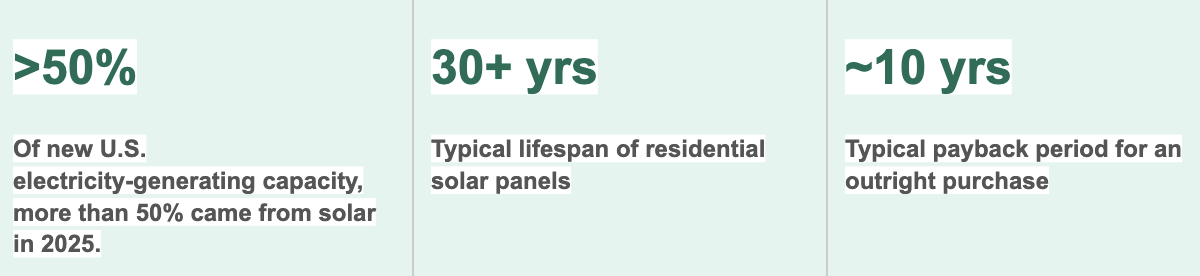
For utility-scale projects, solar continues to capture an ever-increasing market share. In 2025, solar accounted for more than half of new U.S. electricity-generating capacity (fossil fuels accounted for 7%, with wind and battery storage making up the remainder). But you don’t have to be “utility scale” to enjoy the advantages of solar power.

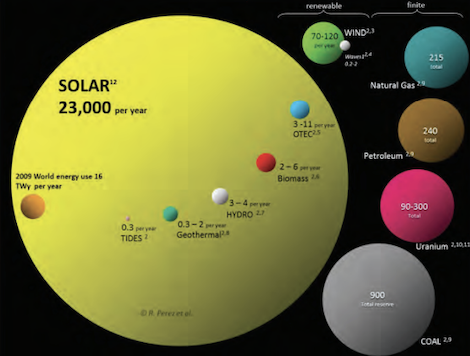
Even without the homeowner solar tax credit, the net cost of solar for the residential sector is less than it was five years ago (there has been a significant decrease in the price of solar panels, along with a marked increase in electricity prices). And is it any wonder? The energy reaching the Earth from the sun dwarfs all other sources of energy. Unlike fossil fuels, it is free for everyone. This pictograph says it all.


Solar can be a part of everyone’s energy supply — renter or homeowner, young or old, with a good site for solar or not a good site. All can benefit. You will save money and help the planet. Let’s look at your present-day options:

Are you a homeowner with a suitable site for rooftop or ground-mounted solar?

How do you know if your home is a suitable site? Here are the determinants: directional orientation of roof (south ideal, but even east/west is feasible), degree of shading by trees, and the age, pitch, and degree of complexity of your roof. Solar companies can quickly tell you if your roof is suitable at no cost. When you visit our Climate Action Fair on May 2, visit a solar vendor to discuss your home site.

If your home site is a good candidate, you have 4 options:

  1. Outright purchase – along with #3 below, provides the highest lifetime savings.Your electricity is nearly free for the 30+ year life of the solar panels. The disadvantage is the upfront cost. It will take 10 years to get your return on investment.
  2. Loan – With a 10-year loan, the monthly loan expense will be in the ballpark of the amount of your monthly electricity bill. After the loan is paid off, your electricity will cost only a nominal amount for the remaining life of the system.
  3. Prepaid Lease – With the expiration of the 30% residential solar tax credit last year, solar companies have become more creative in their financing options. A 30%+ tax credit still exists for businesses. Leasing through a financing agreement called a Purchase Power Agreement captures this credit. There is an option to buy the solar array at the end of the lease agreement, which is usually 5 years. It rivals #1 for highest lifetime savings. We know of 2 prominent solar companies that offer this option. Revision has “Lease to Own.” Go Solar with Lease-to-Own. Maine Solar Solutions has “Propel Financing,” well described in the YouTube video below.
  4. Outright Lease – You may have seen the internet ads for “free solar” or had a visit from a salesperson. These sound like a scam, but legitimate companies exist. Essentially, you are renting your roof to a solar company that profits from the energy generated. In turn, the company offers the homeowner a discount on the energy generated. In this model, the solar company installs the panels on your roof at no expense to you. You receive about a 30% discount on the energy produced. You do not own the panels, and the lifetime savings are less than with the other options. We are aware of one company that has this option available: Freedom Forever.

Each of these options offers a different path to the same goal: lowering your energy costs and reducing your reliance on fossil fuels. The right choice depends on your financial situation, your home, and your long-term goals.

View All Resources